
Many organizations treat artificial intelligence like a checklist of disconnected experiments, purchasing a few SaaS licenses here, spinning up an isolated proof-of-concept there, and hoping one of them sticks. Without a unified plan, budgets scatter, IT teams become overwhelmed by competing requests, and promising ideas stall long before reaching production.
An Enterprise AI Roadmap replaces guesswork with an actionable, sequenced blueprint. Instead of chasing every trend at once, a well-researched roadmap aligns leadership around measurable KPIs, ranks initiatives by business value and technical feasibility, and builds strict security guardrails into every phase.
Here is how Atlantic BT partners with mature organizations to build practical, ROI-first AI roadmaps that move smoothly from initial discovery to live deployment.
Why Ad-Hoc AI Adoption Fails to Scale
When companies skip formal roadmapping and jump straight into tool selection, three predictable roadblocks emerge:
- Chasing Complexity Over Value: Teams often gravitate toward flashy, high-effort generative AI projects while overlooking straightforward workflow automations that could save hundreds of staff hours within weeks.
- Unaligned Departmental Priorities: Sales, finance, operations, and IT frequently define “success” differently—leading to competing pilots that duplicate effort and fragment data across silos.
- Late-Stage Security and Compliance Roadblocks: Treating data privacy as an afterthought means a prototype can pass technical testing only to get blocked by legal or infosec teams right before launch.
The 4 Core Pillars of an Effective Enterprise AI Roadmap
Drawing on more than 25 years of enterprise software engineering experience, Atlantic BT structures every AI roadmap around four disciplined steps, turning strategic ambition into predictable execution:
1. Workflow Auditing and Stakeholder Alignment
Before evaluating models or vendors, our senior architects interview your teams, conduct a full systems inventory, and map how data currently moves across your organization. By pinpointing the exact operational bottlenecks slowing down your staff, we anchor every proposed initiative to concrete financial or productivity KPIs—ensuring executive sponsors and daily end-users share the same definition of ROI from day one.
2. Impact vs. Effort Use-Case Prioritization
Not every problem requires artificial intelligence, and not every AI opportunity should be tackled at once. We score potential use cases across business value, data readiness, and implementation complexity:
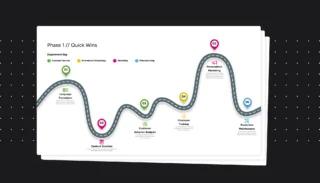
- Quick Wins (High Impact, Lower Effort): Targeted automations—such as intelligent document processing, automated CRM enrichment, or internal knowledge retrieval—that deliver fast, measurable returns and build organizational momentum.
- Strategic Initiatives (High Impact, Higher Complexity): Deeper operational transformations—such as predictive Enterprise Resource Planning (ERP) demand forecasting or multi-system enterprise chatbot integration—sequenced cleanly once foundational data pipelines are in place.
3. Rapid AI Prototyping to Validate Before Building
A roadmap shouldn’t lock you into months of blind engineering. Early in the process, we use rapid AI prototyping to build workable, interactive models tested against real operational scenarios. Putting a functional prototype in front of stakeholders validates user experience, exposes edge-case data issues early, and confirms model accuracy before full-scale development begins.
4. SOC 2 Type 2 Governance and Vendor-Agnostic Architecture
Sustainable AI scale requires trust. Backed by SOC 2 Type 2 certified practices, we embed data privacy, encryption standards, role-based access controls, and human-in-the-loop review workflows directly into your roadmap. Because our consultants are completely vendor-agnostic, we recommend models and architectures strictly based on your security requirements and existing tech stack—avoiding unnecessary licensing lock-in.
Realistic Timelines: What to Expect From Roadmap to Rollout
Depending on the size of your organization and the readiness of your underlying data, moving from initial AI roadmap discovery through architecture, prototyping, and production deployment typically takes 3 to 9 months.
With modern AI-assisted development and automated testing tools accelerating build cycles, your team doesn’t have to wait a year to see results. Phased roadmaps allow you to deploy high-priority automations incrementally, capturing measurable efficiency gains while laying the architectural foundation for future phases.
Turn AI Ambition Into a Clear, Actionable Blueprint
The difference between an AI experiment that stalls and an AI system that transforms daily operations comes down to planning, governance, and disciplined execution. With a senior-led, ROI-first roadmap guiding your investments, your organization can adopt intelligent automation with clarity and confidence.
Ready to prioritize your highest-value AI opportunities and build a step-by-step implementation plan? Explore our AI Strategy Services to see how Atlantic BT partners with your team from initial roadmap through live deployment.