
Across nearly every industry, organizations are rushing to experiment with artificial intelligence. Yet according to Gartner, only about 41% of generative AI prototypes ever make it into live production.
Why do nearly three out of five AI initiatives stall before delivering business value? In most cases, companies jump straight into testing flashy tools without first evaluating their underlying data readiness, security guardrails, or operational workflows. A standalone demo might look impressive in a boardroom, but without clean integrations into core systems and clear accountability around return on investment, it quickly becomes shelfware.
A disciplined AI Strategy closes that gap. By connecting upfront discovery with phased execution, mature organizations move past disconnected experiments and deploy intelligent automation that reduces costs, accelerates workflows, and scales safely.
Here is how four core pillars, AI Consulting, AI Roadmapping, AI Integration, and Chatbot Integration, work together to take your AI initiatives from concept to production.
1. AI Consulting: Starting With Business Outcomes, Not Tools
The biggest mistake companies make with artificial intelligence is treating it as a solution in search of a problem. Effective AI consulting flips that equation—starting with your operational friction points, data infrastructure, and measurable KPIs before recommending a single model or platform.
At Atlantic BT, our senior architects and consultants take an ROI-first, vendor-agnostic approach:
- Workflow and Systems Auditing: We interview your teams, inventory existing databases, and document daily processes to uncover where manual bottlenecks actually slow down revenue or productivity.
- Data Readiness Evaluation: AI models are only as reliable as the data feeding them. We assess whether your customer records, operational logs, and internal documentation are structured and accessible enough to support accurate outputs.
- SOC 2 Type 2 Security and Governance: Enterprise AI requires strict boundaries. Backed by SOC 2 Type 2 certified practices, we establish clear data privacy and compliance frameworks early so proprietary company data and customer records remain protected.
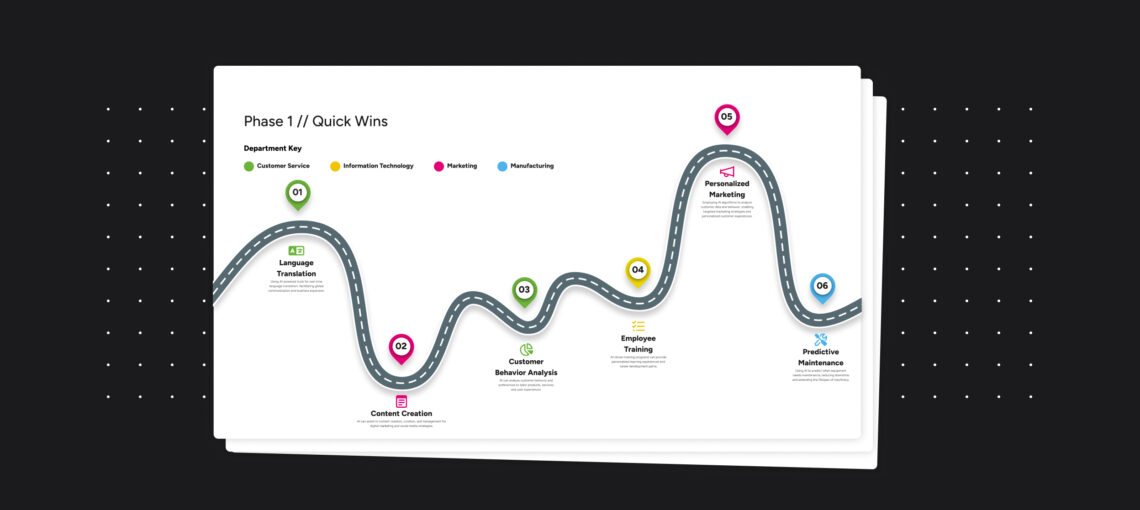
2. The AI Roadmap: Prioritizing High-Impact, Low-Effort Wins
Once discovery uncovers where AI can create genuine value, leadership needs a clear, realistic blueprint for execution—not a vague multi-year wish list.
A customized AI Roadmap translates strategic goals into a step-by-step implementation plan:
- Impact vs. Effort Prioritization: Rather than betting your entire budget on a massive, high-risk overhaul, we sequence initiatives to capture high-impact, lower-effort wins first—proving ROI early and building organizational momentum.
- Rapid AI Prototyping: Before committing to full-scale engineering, we build workable prototypes early in the lifecycle to test real user experiences, validate model accuracy against your data, and secure stakeholder sign-off.
- Predictable Timelines and Budgets: Depending on organizational complexity, a comprehensive AI strategy typically moves from initial discovery and architecture through production deployment within 3 to 9 months, with AI-assisted development tools accelerating build and testing cycles along the way.
3. AI Integration: Embedding Intelligence Into Core Operations
Standalone AI tools force employees to constantly switch tabs, copy-paste context, and manually transfer outputs back into your core business systems. True AI integration eliminates that friction by embedding intelligence directly into the applications your teams already rely on every day.
Whether connecting private language models or machine learning pipelines to your Enterprise Resource Planning (ERP) platform, Customer Relationship Management (CRM) system, or custom internal portals, tailored integrations unlock measurable efficiency across departments:
- Workflow Automation: Automatically extract, validate, and route data from invoices, vendor contracts, and compliance forms straight into your backend databases.
- Business Intelligence and Predictive Insights: Analyze high volumes of historical sales, supply chain, and operational data to forecast demand shifts and surface actionable recommendations for leadership.
- Marketing and Customer Analytics: Synthesize website behavior and customer engagement patterns to personalize outreach and spot emerging market trends faster.
- Automated Threat Monitoring: Enhance cybersecurity posture with intelligent monitoring that detects anomalies and flags potential vulnerabilities before they disrupt operations.
4. Chatbot Integration: Smarter Self-Service for Customers and Staff
While behind-the-scenes automation drives massive operational savings, chatbot integration transforms how customers and employees interact with your business in real time.
Unlike rigid, rule-based bots that frustrate users with scripted dead ends, modern enterprise chatbots powered by Natural Language Processing (NLP) and securely connected to your live business data deliver genuinely helpful, context-aware experiences:
- 24/7 Customer Support and Triage: Answer complex product or account questions accurately using your approved knowledge base, check live order statuses from your ERP, and seamlessly escalate nuanced issues to human agents with full conversation context.
- Lead Qualification and Guided Onboarding: Engage website visitors with tailored recommendations, answer technical pre-sales questions, and route qualified prospects directly into your CRM.
- Internal Employee Assistants: Give staff an instant, natural-language interface to query internal SOPs, HR policies, IT troubleshooting steps, or inventory availability—cutting down internal support tickets and onboarding time.
Why Senior Engineering Experience Matters in AI Strategy
Because AI touches your data architecture, security posture, and daily user workflows simultaneously, successful execution requires more than prompt engineering—it demands decades of disciplined software architecture experience.
With over 25 years of enterprise software engineering and SOC 2 Type 2 certified practices, Atlantic BT partners directly with your team from initial discovery and rapid prototyping through full-scale integration and ongoing optimization—ensuring your AI investments reach production and deliver lasting business value.
Ready to turn AI concepts into secure, ROI-driven business systems? Explore our AI Strategy Services to see how Atlantic BT helps organizations build, integrate, and scale intelligent automation.