Skip to content
Article

Most Web Design Isn’t Good. But Does It Have to Be?

We’ve written ad nauseum about the ins-and-outs of taxonomy. Which is important, but as dry as a talk on the Dewey Decimal System.

Marketers are, by and large, focused on concerns that arise daily. They want to know how many visitors they can convert and how many dollars come from said conversions. The producible vs. theoretical is how they keep their careers in the black.

Staying in the black is a base concern for any business owner. It’s required for the business to be, well, a business. It’s the same reason businesses are risk adverse toward having opinions. Or why they hesitate when they hear the price tag for a new website with rich design and functionality.

Owners will often share how much they paid for their current website. Even if the site is several years old, they’ll insist that it still continues to produce new customers. It’s easy to understand. They are a concerned business owner trying to minimize their costs. Unfortunately, they’re not seeing the value of design. When this happens, we have to wonder. Are people obstinate or can they not see how bad their websites are?

Why Web Design Doesn’t Always Translate to Profit
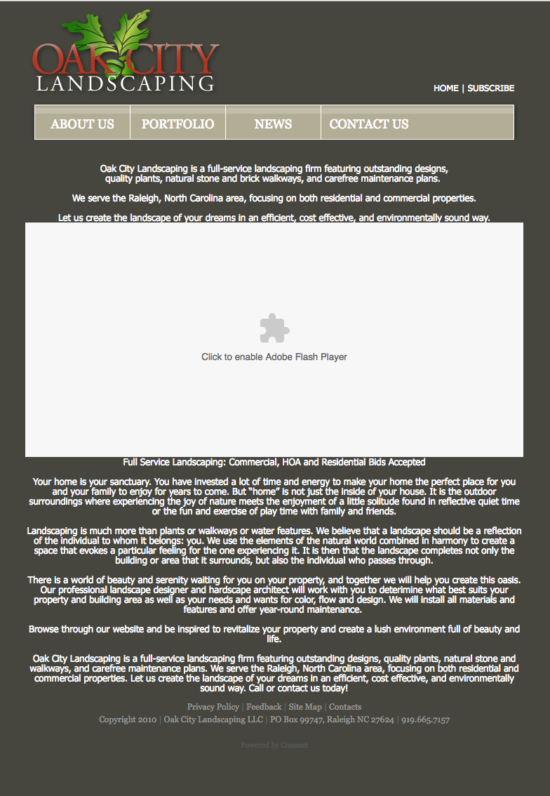
This site is a good example of Raleigh web design: outdated and not often updated, but does well for SEO.
This site, which hasn’t been updated in almost a decade, still ranks in the top 10 for “Raleigh landscaping”

Sometimes people enjoy stating their personal worldview as a generally accepted fact, as in, “Bob, everyone knows you can’t skin a beaver with two shakes of a lamb’s tail.” You should be skeptical of statements of “fact”. In other words, take the following statement with a grain of salt:

You don’t have to have a pretty website to be successful. We have physically seen multiple websites and datasets that prove sites can compete and win business despite being ugly, dated, and not matching an aesthetic that anyone enjoys looking at. Sites that continue to win business despite seemingly ignoring what their customers want. Of course, the assumption is that good design is what people want.

Winning Customers In Spite of Bad Web Design

The problem with arguing that a site should be redesigned is, in many cases, your customers just don’t care. They aren’t looking for someone with an immaculately crafted website or even good brand. A customer who needs a plumber doesn’t care about site design; they want someone who can reliably fix a clogged pipe for a relatively cheap price. An organization who wants in-depth customer analysis doesn’t mind a bland-looking site; they want a company with proven expertise in data analysis.

In both these examples, the customer need can be so specific that it transcends the website (really only one portion of a much larger brand). There are all kinds of scenarios where a new website may not be the answer.

1. Your Consumers (and Business) Are Local

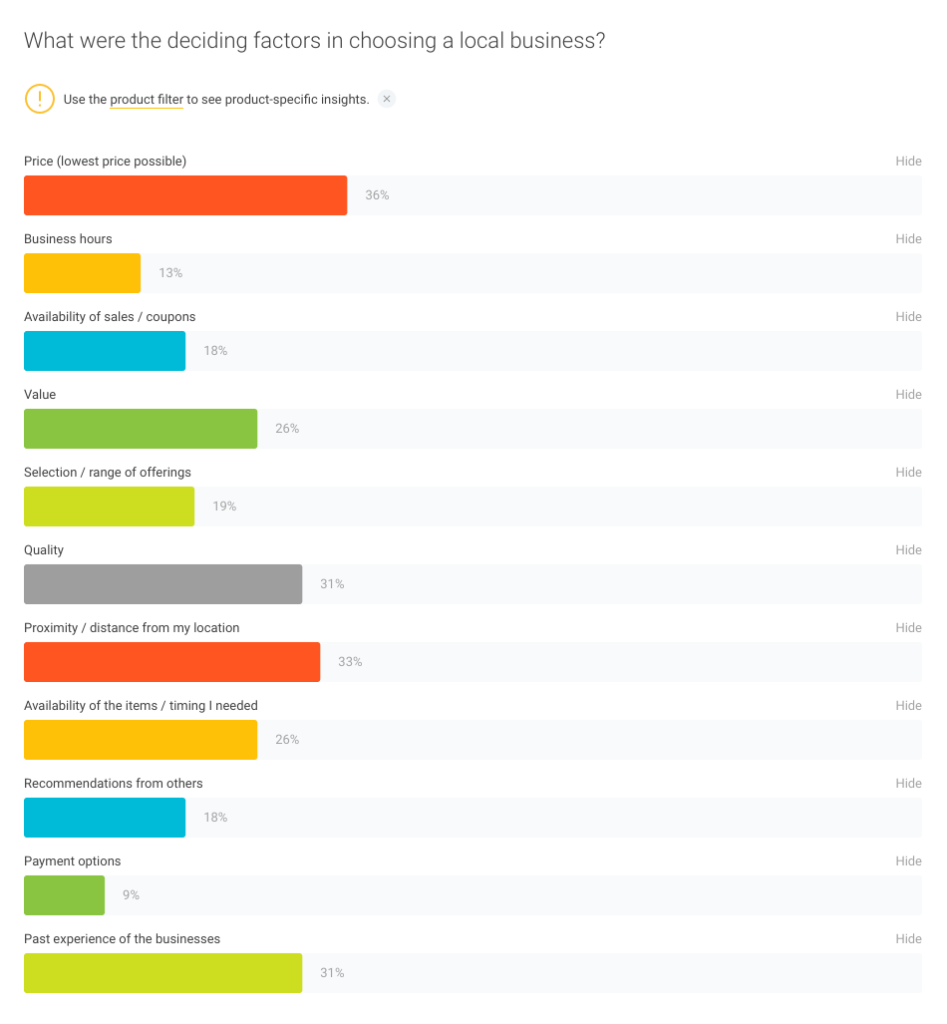
If you offer a local service (like electricians or plumbers) and most of your customers are local, you can probably get away with having an exceptionally ugly website and still be successful. Why? Because most people have bigger concerns. According to Consumer Barometer with Google, Price, Proximity, Quality, and Past Experience with Business were the biggest factors in how customers choose a local business.
Web design may be the furthest thing from your visitor's mind.
Web design may be the furthest thing from your visitor’s mind.

This is especially true when you consider how having good reviews and local listings play into converting customers. We already know that quantity and quality of reviews play a factor for local SEO (meaning oft-reviewed businesses are more visible). But even more to the point, an estimated 50% of consumers make a very quick decision on whether to hire someone based on reviews and may not even visit your website. 

We’ve personally seen this in our own data sets—phone call conversions represent up to 50% of all conversions with no corresponding website visit.

2. You Rank Well on Google (or Your Brand Is Well-Known)

Sometimes, you’re so successful at marketing that you succeed despite your disheveled digital appearance. Let’s pick on Oak City Landscaping, a Raleigh landscaping company, as an example of a dated website that still does well for SEO.

This site is dated. Our educated guess is it was originally put up around 2010 (according to WayBackMachine) and doesn’t appear to have fundamentally changed since then. It’s still using Flash, meta keyword tags, and isn’t responsive. Despite all that, it still ranks 9th on Google for “Raleigh landscaper”.

We have no idea how well organic traffic drives results for this company, since we don’t have access to their analytics. However, it is a good example of how design, even if it’s unappealing and outdated, does not necessarily prevent a website from reaching and converting its customers.

We’ve always believed making consumers aware of your company is the first step towards making them a customer. Awareness of your brand, even through non-digital sources, can effectively nullify the importance of your site.

3. Re-engagement and Loyalty

We talk to so many clients who act as if customer loyalty is some great mystery they will never understand. Take email marketing as an example. Despite its low cost and relatively low barrier to entry, many companies fail to use simple emails to reengage past customers. The worst examples are email-only newsletters with no attached website.

You want to keep customers aware you exist by updating them about a particular service, seasonal event, or concept. Forrester Research showed the potential return on investment for customer loyalty programs could range between 42% to 61% (despite companies continuing to invest in acquisition over retention).

Whether you’re offering referral bonuses, incentives for continued loyalty, or educational materials to keep your customers up-to-date, loyalty matters. It places the emphasis on actual interaction and brand experience versus merely the experience of your website.

Do I Need A New Website?

We’re going to blow your mind right now: if you go to an organization that sells something, they’ll probably try to sell you that thing. If you start a conversation with a web design company, they are likely going to recommend a new website to improve your bottom line.

Our argument is there are many cases where your business goals may be better fulfilled with things that aren’t another website. This is the explicit promise of our Discovery Process, which we designed to assess the most appropriate things needed to accomplish business owner goals, rather than hawking you website design you don’t need. If you’re interested in starting the conversation about what will best accomplish your marketing goals, feel free to contact us.

The Atlantic BT Manifesto

The Ultimate Guide To Planning A Complex Web Project

Insights

Atlantic BT's Insights

We’re sharing the latest concepts in tech, design, and software development. Learn more about our findings.

Questions & Answers

How do you build an information architecture that allows our internal team to add future product lines or content hubs without breaking the navigation framework?

We build information architecture with future scaling in mind by explicitly mapping your long-term business goals during the initial design phase and engineering a flexible Content Management System (CMS) that allows your internal team to autonomously add new pages and navigation elements.

Our approach to scalable digital architecture focuses on two core pillars:

  • Future-Proof Structural Design: We analyze your business roadmap to anticipate upcoming product lines, acquisitions, or content hubs. Instead of building rigid, static menus, we design flexible navigation frameworks and site taxonomies that accommodate new structural tiers without requiring a backend redesign.
  • Dynamic Content Management System (CMS) Engineering: We configure your CMS with modular component blueprints and intuitive navigation controls. This allows your internal team to independently launch new product pages, build out comprehensive resource centers, and update global menus while maintaining strict brand consistency and site stability.

Learn More about How do you build an information architecture that allows our internal team to add future product lines or content hubs without breaking the navigation framework?
How do you start building your information architecture?

We begin building your information architecture by taking a full inventory of your current digital footprint, aligning with your business goals, mapping user pain points, and collaborating directly with your internal team to workshop the optimal site structure.

Our foundational architecture process consists of four precise phases:

  • Comprehensive Content Inventory & Audit: We catalog every existing page, asset, and data point on your current site to evaluate performance, identify redundant content, and establish an accurate baseline for migration.
  • Business Goal & KPI Alignment: We analyze your corporate growth objectives to ensure the site taxonomy structurally prioritizes your highest-value products, services, and conversion paths.
  • User Pain Point Mapping: We isolate friction points within your current navigation, analyzing where users drop off or struggle to locate critical technical, support, or procurement data.
  • Collaborative Structure Workshops: We run hands-on, strategic workshops with your key stakeholders to co-create, test, and finalize a logical sitemap and structural hierarchy that satisfies both user intent and internal operational requirements.

Learn More about How do you start building your information architecture?
How do your UX designers collaborate with our internal software engineers to ensure technical feasibility?

We ensure technical feasibility by integrating your internal software engineering team into our design process from the very beginning of the project, establishing continuous alignment from discovery through final handoff.

Our collaborative framework with internal development teams operates across three key phases:

  • Discovery & Stakeholder Interviews: We include your engineers in the initial technical discovery sessions to understand your existing tech stack, legacy constraints, data architecture, and framework limitations before any design begins.
  • Iterative Design Reviews: We conduct regular technical review sessions during the wireframing and prototyping phases. This allows your development team to vet the technical feasibility of interactive components, animations, and data layouts before they are finalized.
  • Structured Collaborative Handoff: We execute a comprehensive technical handoff, translating high-fidelity prototypes into component-driven design systems with exact CSS values, asset libraries, and behavior logic to match your developers' workflow.

Learn More about How do your UX designers collaborate with our internal software engineers to ensure technical feasibility?
Do you deliver comprehensive design systems and documentation for our development team to use long-term?

Yes, we deliver a fully comprehensive design system and complete documentation upon project completion, ensuring your internal development team and company have all the assets needed for long-term product scaling and brand consistency.

Our standard engineering handoff package includes:

  • Comprehensive Branding Guidelines: Detailed documentation covering corporate color palettes, typography hierarchies, logo usage rules, and asset spacing guidelines to maintain brand alignment.
  • Strategic Concept Boards: The foundational visual and thematic direction of your digital ecosystem, mapping out the creative rationale and aesthetic styling behind the custom interface.
  • Component-Driven UI Kits: An organized library of reusable user interface components (including buttons, form fields, navigation bars, and icon sets) built to map directly to reusable code blocks for your engineering team.
  • High-Fidelity Interactive Mockups: Pixel-perfect screen designs visualizing the application across multiple device breakpoints, including interactive transitions and responsive logic.

Learn More about Do you deliver comprehensive design systems and documentation for our development team to use long-term?
Do you conduct usability testing with our actual target audience?

Yes, whenever possible, our primary goal is to test with your actual end-users, whether they are your external customers or internal team members. We utilize a flexible approach that respects data privacy and aligns with your project scope.

Because we operate as a third-party agency, we do not have direct access to your proprietary customer databases or internal user lists due to security and privacy protocols. Instead, we collaborate with you across three distinct testing scenarios depending on access, resource availability, and budget:

  • Client-Facilitated User Testing: If you have direct access to your end-users or internal teams and can facilitate the introduction, we handle the orchestration, scriptwriting, and moderate the live usability testing sessions to gather direct qualitative feedback.
  • Agency-Led "Potential User" Recruitment: If reaching your current users isn’t feasible, our team steps in to recruit "potential users." These are vetted participants who match the exact professional demographics, technical skill levels, and behaviors of your target audience.
  • Strategic Persona Workshops & Heuristic Evaluations: If project timeline, scope, or budget constraints make live testing impractical, we pivot to expert-led methodologies. We conduct collaborative persona workshops with your stakeholders and run comprehensive heuristic evaluations (expert UX reviews) to map user journeys based on established behavioral psychology standards.

Learn More about Do you conduct usability testing with our actual target audience?
How much does a custom web application cost?

The investment for a custom web application typically ranges from $50,000 to $200,000+, depending on the complexity of the feature set, the number of user roles, the depth of data integrations, and specific security compliance requirements.

We categorize development into three strategic engineering tiers:

  • Minimum Viable Product / Core Web App ($50,000 – $80,000): Ideal for launching a first-generation custom tool or migrating a single manual workflow online. This includes a fully custom UI/UX design, a relational database setup, standard secure user authentication (login/signup), and core functional features for 1–2 distinct user roles (e.g., client vs. administrator).
  • Advanced Scale & Client Portals ($80,000 – $150,000): Built for mid-market and enterprise companies looking to centralize operations. This tier covers complex, multi-tenant architectures (portals with unique user views), custom API layers to sync data with external CRMs or ERPs, advanced search/filtering, automated PDF/report generation, and interactive data dashboards.
  • Enterprise Application Ecosystem ($150,000+): Mission-critical software built for global organizations. This includes heavy legacy system synchronization, architecture for infinite scalability, data pipelines, machine learning or AI integration, and rigid compliance standards (SOC 2, HIPAA, or ISO 27001).

Learn More about How much does a custom web application cost?
Do you provide ongoing support after the launch?

Yes! Our custom web application maintenance includes a range of critical services: from regular updates and security patches to adding new features and strategic planning. These continuous efforts ensure that a website remains secure, efficient, and aligned with your business’s goals.

Learn More about Do you provide ongoing support after the launch?