

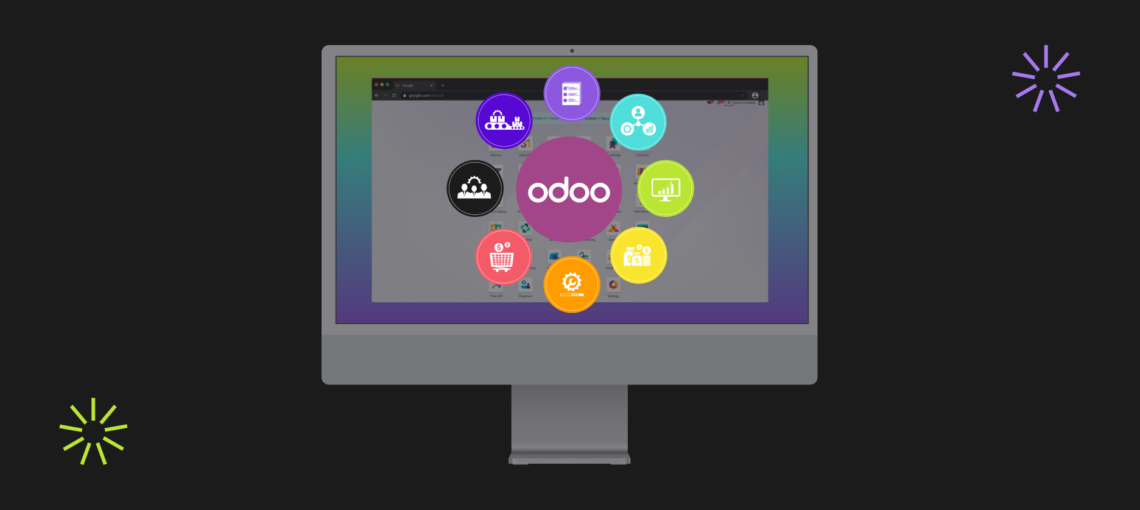

Disparate Systems Are Holding Your Business Back
As a tech agency, we talk to business leaders every day who are battling the same problem. They have great teams, but their technology stack is holding them back.
If this sounds familiar, you’re not alone. I see it time and again as a Business Analyst: a separate accounting system that doesn’t talk to the CRM, a standalone inventory tool, and a whole lot of manual data entry and spreadsheets being used to connect the dots. These disparate systems create data silos, slow down operations, and leave you constantly playing catch-up.
What is Odoo Software?
This is precisely where Odoo (formerly OpenERP) steps in. So, what is Odoo Software? It’s a comprehensive suite of business applications designed to manage all aspects of a company’s operations; from CRM and Sales to Inventory and Accounting. What sets Odoo Software apart is its modular and open-source foundation, offering a single, unified system that can eliminate those integration headaches for good.
But should your business place its bets on Odoo to unify its processes? The decision hinges on carefully weighing its core strengths and weaknesses.
The Pros of Choosing Odoo Sotfware
Odoo’s architecture and approach bring several compelling advantages, especially for small to mid-sized enterprises (SMEs) and fast-growing businesses.
- Modular and Integrated Design (All-in-One): Odoo Software offers over 30 core modules and thousands of community apps. You can start with just the essential apps (e.g., Sales and Inventory) and seamlessly add more (e.g., HR, Manufacturing) as your business grows, all of which are natively integrated. This unification of data and processes is a major plus.
- Open-Source and Customizable: As an open-source platform, Odoo provides a level of control and flexibility that proprietary ERPs often lack. Businesses can modify existing applications, build new features, and connect Odoo with other software using its API. This high degree of customization is ideal for companies with specific, unique workflows.
- Cost-Effective Entry Point: The Community Edition is free and open-source, offering essential ERP features. While the Enterprise Edition; required for advanced features, official support, and Odoo’s cloud hosting, comes with a subscription, its overall total cost of ownership is generally considered more affordable for SMEs compared to large-scale competitors like SAP or Oracle.
- User-Friendly Interface: Odoo is known for its modern, clean, and intuitive user interface. Its design is intended to be accessible, which can lead to faster user adoption across different departments with less extensive training.
Strong Community and Ecosystem: The active global community contributes a vast repository of third-party add-ons, integrations, and continuous improvements, providing a rich, evolving ecosystem around the core platform.
The Cons and Limitations of Odoo
While powerful, Odoo is not without its challenges. These limitations are critical to consider, especially for larger or more complex organizations.
- Steep Learning Curve for Customization: Although the out-of-the-box interface is user-friendly, implementing complex customizations requires significant technical expertise (often Python development skills). Businesses without an in-house technical team will likely need to rely heavily on expensive third-party consultants or certified partners, increasing implementation costs and time.
- Hidden and Escalating Costs: The appealing low entry price can be misleading. As a business scales, adding users and requiring more than one core app often necessitates upgrading to the Enterprise Edition. Furthermore, the cost of customizations, integrations with non-Odoo systems, and dedicated partner support can quickly add up, leading to a higher-than-expected total cost.
- Limited Advanced Features for Large Enterprises: Odoo is best suited for small to mid-sized businesses with fairly standard operations. For large, complex multinational corporations requiring highly advanced features—such as sophisticated supply chain planning, multi-entity consolidation, or extensive AI-driven analytics—Odoo’s out-of-the-box capabilities may be too basic.
- Support and Dependency: While the community is large, official customer support for the Enterprise edition can sometimes be inconsistent or slow, particularly for niche or unusual bugs. Reliance on external partners for maintenance and bug fixes can also create dependency issues.
Performance Concerns with Scale: For organizations with massive transaction volumes or complex, high-data workflows, Odoo has been reported to experience performance slowdowns, making scalability a serious consideration for rapidly expanding businesses.
Is Odoo Software Right for Your Agency?
Here is my take, based on years of seeing how businesses struggle with fractured systems: Odoo is an incredible solution if your primary pain point is the lack of communication between your critical business applications.
If you are a startup or a growing SME that values flexibility, modularity, and an all-in-one platform, Odoo Software is a fantastic option. It’s particularly strong for businesses looking to unify core functions like e-commerce, sales, and inventory management into one integrated system, finally letting go of that jumble of separate tools and manual reconciliation via spreadsheets.
By consolidating your disparate systems into one unified ERP, Odoo Software can offer the cohesive foundation you need to scale efficiently.
However, be realistic about your needs. If your business is a large enterprise with highly complex, non-standard processes, requires rock-solid 24/7 mission-critical support, or cannot tolerate the added technical cost and time associated with deep customization, you may find Odoo’s limitations too restrictive.
The final choice must be guided by a thorough analysis of your unique workflow requirements against Odoo’s native features to determine the true cost of customization and long-term viability.
Would you like me to draft a more detailed section focusing on the key Odoo modules most relevant to a tech agency, such as Project Management, Time Tracking, and Invoicing?


