


What is Dark Data?
Dark data is the volume of unstructured and untapped information that an organization collects during daily business but fails to use for analytics or decision-making. In a large enterprise, this typically accounts for nearly 80% of all stored data. According to projections from IDC, this unstructured information makes up the vast majority of the global datasphere.
For example, a global manufacturing firm might store decades of maintenance logs and technician notes in PDF formats and local folders. While the company pays to store this data, it is effectively invisible to leadership. Because no one has indexed or integrated this data into a centralized system, the C-suite cannot query it for patterns. This results in missed predictive maintenance opportunities that could save millions in downtime.
Shining a Light with Custom API Integrations
AI is only as good as the data it can reach. Building pipelines that connect dark repositories like an old on-prem ERP or a cluttered SharePoint to a modern AI engine ensures the system understands your specific business history.
Implementing Retrieval-Augmented Generation (RAG)
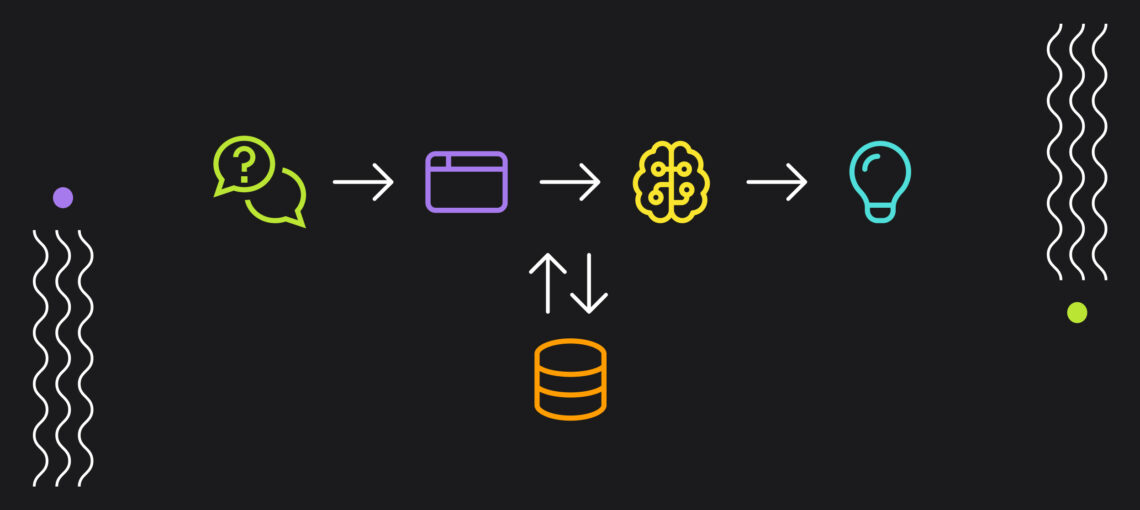
Retrieval-Augmented Generation (RAG) is a technical framework. it enables a Large Language Model to access specific, private data sources before it generates a response. Rather than relying on general training, RAG allows the system to look up archived information from internal databases.
- The Tech: Vector databases index dark PDFs, Slack threads, and documentation. They convert text into numerical vectors that the AI can understand.
- The Method: Hybrid Search combines traditional keyword search with AI semantic search. This ensures the system finds the exact, verified record you need rather than just documents that sound similar.
1. Internal Wikis and Slack
- The Dark Data: Years of project decisions and troubleshooting guides buried in Slack channels or outdated Confluence pages.
- The AI Integration: A custom RAG pipeline indexes these conversations.
- The Result: A new engineer can ask how a specific server migration was handled in 2022. They get an instant summary instead of asking a senior lead to search through old threads.
2. Legacy ERP Systems
- The Dark Data: Historical sales records or inventory logs trapped in an old ERP system that is difficult to query.
- The AI Integration: A Text-to-SQL interface acts as a secure wrapper around the legacy database.
- The Result: A department head types a request to see sales dips in Q3 of 2019. The AI translates the request into a database query and returns a clean chart instantly.
Security-First Integration
Organizations often fear that AI will surface sensitive data to the wrong people. Proper integration maps AI access directly to your existing security protocols.
1. Governed Data Access (RBAC)
- The Problem: Unified search might accidentally show sensitive executive payroll or legal files to unauthorized employees.
- The Connection: An integration with an identity provider like Okta or Azure AD allows the AI to inherit existing Role-Based Access Controls.
- The AI Result: The AI checks credentials in real-time. If a user lacks permission to view the source file, the AI excludes that data from its response.
2. Automated PII Redaction
- The Problem: Customer support logs often contain social security numbers or credit card data that should not enter an AI engine.
- The Connection: A security gateway between the data source and the AI engine identifies and masks sensitive strings.
- The AI Result: The AI summarizes customer sentiment while masking personal details. This protects privacy while providing the necessary business insights.
3. Compliance and Audit Trails
- The Problem: Large organizations must prove who accessed data to satisfy HIPAA or GDPR regulations.
- The Connection: An integration layer captures and logs every prompt and every data source the AI used.
- The AI Result: Compliance officers review a complete audit trail of AI interactions. This keeps integrated intelligence transparent and accountable.
Building System Bridges
Real intelligence happens in the gaps between software. Most companies struggle with siloed intelligence where marketing data never reaches the operations team. To solve this, you must turn isolated programs into a unified ecosystem.
1. CRM and ERP Integration
- The Problem: Sales teams work in the CRM, but inventory logic lives in a legacy ERP. Reps must manually email other departments to check custom order status.
- The Connection: A middleware integration allows an AI agent to read both systems simultaneously.
- The AI Result: A rep asks if they can fulfill 500 units by Friday at a 10% discount. The AI checks stock in the ERP and contract terms in the CRM to generate a quote instantly.
2. Helpdesk, Knowledge Base, and Slack
- The Problem: Client history is in Zendesk, technical issues are in Jira, and the fix is buried in a Slack thread.
- The Connection: These disparate APIs integrate into a unified vector database.
- The AI Result: When a ticket arrives, the AI scans Jira and Slack history. It presents the agent with a summary of how a developer fixed the same bug in the past.
3. HRIS, Internal Wiki, and Training Portals
- The Problem: New hires waste time looking for policies spread across HR portals, SharePoint, and various documents.
- The Connection: A search wrapper connects to all internal document repositories via secure APIs.
- The AI Result: An employee asks a private company bot for the reimbursement policy. The AI pulls the specific paragraph from the SharePoint PDF and provides the direct link.
Turn Dark Data Into Insights
Turning dark data into a strategic advantage requires a deep understanding of legacy architecture and API security. Atlantic BT helps organizations master their data. We audit your ecosystem to find hidden value, build custom middleware to bridge silos, and wrap every integration in a governance layer.
Stop letting valuable insights gather digital dust. Talk with our team to learn how we can build the integrations that turn your dark data into a unified engine for growth.


