

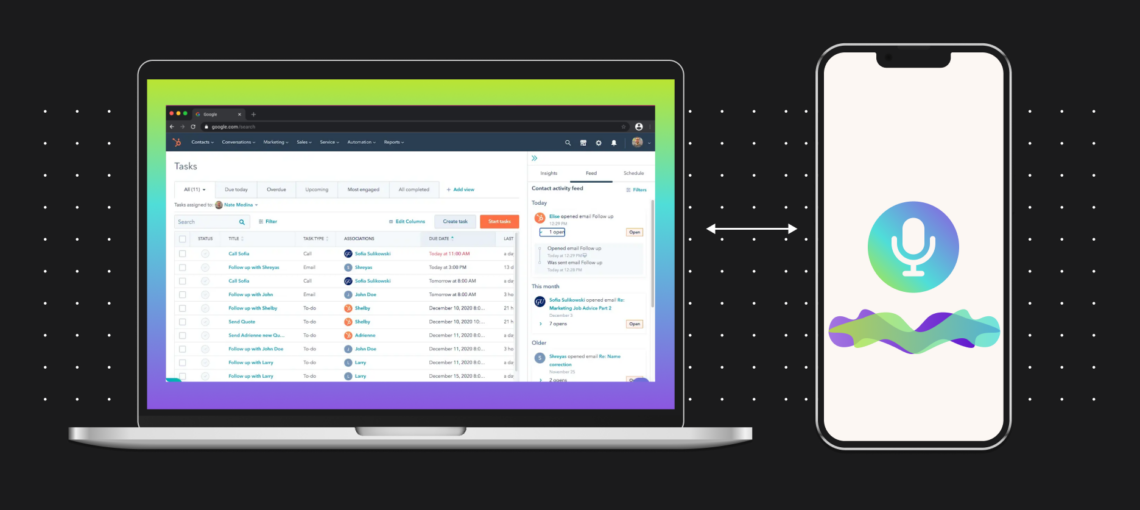

The promise of an AI voice assistant is simple; it’s a faster, smarter customer service. However, for a voice assistant to be truly smart, not just a fancy Interactive Voice Response (IVR), it must be able to access and update customer data in real-time. This is where the rubber meets the road: the essential but technically challenging process of integrating the AI system with your core business platforms, such as your CRM (Customer Relationship Management) and Legacy Systems.
AI Voice Assistant CRM Integration Challenge
When a customer calls, they expect the voice assistant to know who they are, what products they own, and the status of their last service ticket. Without integration, the AI is deaf and blind, limited to generic scripts.
The challenge isn’t just connectivity; it’s navigating the complexity of existing enterprise architecture:
- Data Silos: Customer information often lives in multiple, disconnected systems- the CRM, an ancient ERP (Enterprise Resource Planning) system, and perhaps a separate ticketing platform.
- Legacy System Constraints: Older systems often lack modern APIs designed for real-time communication, making data extraction difficult and risky.
- Security and Compliance: Exposing sensitive customer data to a new voice platform requires strict adherence to protocols like GDPR, HIPAA, or PCI-DSS.
Overcoming these hurdles is the key to unlocking true personalized automation via a robust AI voice assistant CRM integration.
The Solution: The API-First Middleware Layer
Achieving a “seamless handshake” requires a sophisticated approach that doesn’t force the new AI system to speak the archaic language of the old systems. The most effective technical solution involves an API-First Middleware Layer.
1. The API Gateway (The Translator)
The AI voice assistant never communicates directly with the legacy system. Instead, it sends a standardized request (e.g., “Retrieve Customer ID 123’s last order status”) to a central API Gateway or Integration Layer.
This layer acts as a translator, allowing the AI to use modern communication protocols while the gateway handles the specific, often complex, calls required by the CRM or legacy database.
2. Microservices Architecture (The Specialist)
Within the middleware, dedicated microservices are built to perform single, focused tasks.
- A “Customer Lookup” microservice knows exactly how to query the CRM.
- An “Order Status” microservice knows how to safely pull data from the legacy ERP.
- A “Ticket Creation” microservice handles logging a new issue in the call center software.
This design makes the integration robust. For example, if one legacy system goes down, only that specific microservice fails, minimizing impact on the overall voice assistant functionality and preserving the core AI voice assistant CRM integration functionality.
3. Data Flow Orchestration (The Choreographer)
When a customer asks the AI, “What is the status of my return and can I update my billing address?” the middleware orchestrates a complex dance in milliseconds:
- Authentication: The voice assistant identifies the user.
- Parallel Query: The middleware simultaneously queries the Legacy System (for return status) and the CRM (for current billing address).
- Data Unification: It aggregates the necessary data into a single, clean response package.
Response Delivery: It passes the unified data back to the AI, which generates a natural-sounding, personalized response for the customer.
The Results: Personalized Interactions and a Unified Profile
By treating AI voice assistant CRM integration as a critical infrastructure project, businesses ensure their AI voice assistants are not just answering calls, but are deeply embedded components that drive efficiency and deliver a truly seamless, intelligent customer experience.


